
Suno Prompt Masters Your Questions Answered
(Click here to consider joining)
As an official Group Expert for the Facebook group Suno Prompt Masters, KingMick-Productions is dedicated to supporting the AI music community by answering members' questions, troubleshooting prompt issues, and offering practical guidance. Below, you will find a curated collection of our most helpful advice and answers to common inquiries regarding generative AI music creation. Whether you need assistance with structuring lyrics, crafting nuanced style prompts, or making the most of advanced tools and features on Suno, we are here to help! Feel free to explore our insights below, or join the group to ask your own questions and collaborate with fellow creators!

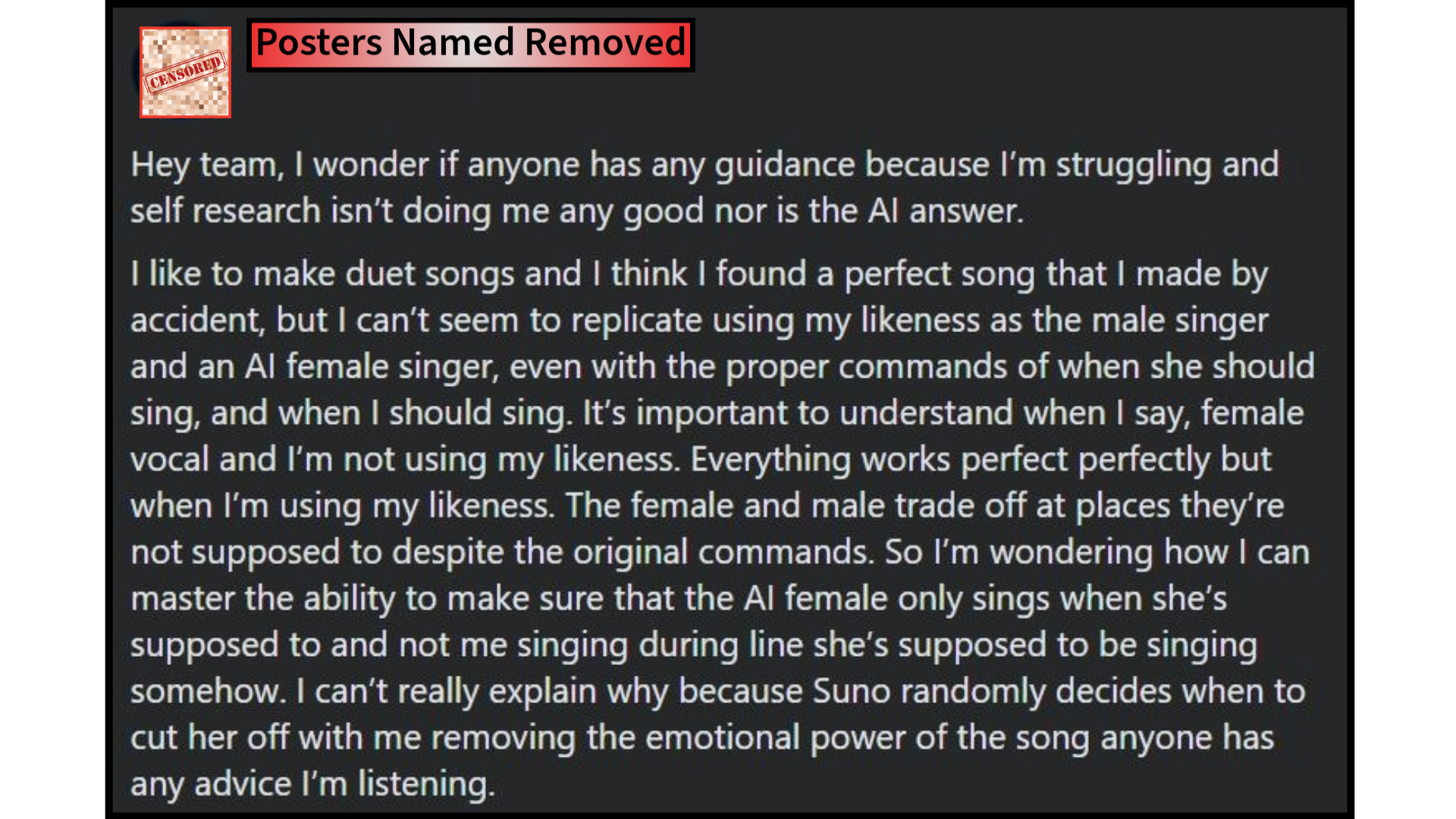
Mastering duets in AI music generators can be quite challenging and often requires trial and error, applying strategic prompting and workflow techniques can significantly improve your results. Below is an expanded guide with practical methods to help you structure, separate, and fine-tune dual-vocal compositions:
Build incrementally (Section-by-Section Workflow): Rather than generating a full song in one attempt, construct your track in smaller segments using the extend feature. Start by perfecting the intro and first verse with a single vocal profile, then extend the track to introduce the second vocalist. This step-by-step approach gives you greater control over voice assignments and prevents the AI from mixing up singers later in the track.
Prevent vocal bleed with transition tags: Vocal bleeding occurs when the generator blends two distinct voices together during transitions. To enforce a clear boundary between singers, insert anti-bleed markers or structural tags whenever the active vocalist changes. Utilizing tags such as [short musical interlude], [instrumental break], or [pause] gives the audio model space to reset its vocal synthesis before the next singer begins.
Use detailed vocal prompts and consistent structural labels: Explicitly define all vocal roles at the very top of your lyric prompt before introducing the song structure. Establish specific vocal profiles, for instance, [vocalist 1; male baritone vocals] and [vocalist 2; airy female vocals], and prepend these exact tags directly above their respective lyric blocks. Reinforce these roles by tagging each section clearly (e.g., [verse 1; baritone male vocals], [verse 2; airy female vocals], or [chorus; alternating lines]) to guide the generator throughout.
Avoid using the word "duet" in style prompts: Including generic terms like "duet" in your style or lyric prompts can trigger automated default formatting in the engine, which frequently ignores custom voice tags and forces random vocal blending. To achieve harmony or simultaneous singing without losing distinct voices, avoid "duet" and use specific direction tags like [both vocalists], [unison chorus], or [dual harmonies] instead.
Keep lyrics gender-neutral and versatile: Write lyric lines that avoid gendered tropes or rigid pitch indicators unless necessary. Neutral phrasing allows the generator to assign lines to either vocal profile without relying on internal linguistic bias to select a singer, preserving your explicit vocal assignments.
Adjust generator settings for precision: Fine-tune your generation parameters to enforce prompt adherence. Lowering the "weirdness" or randomness slider reduces unexpected vocal shifts, while raising the style influence or prompt strength slider forces the model to adhere strictly to your structural tags and custom vocal definitions.

