Site Main Menu

Introduction: The Strategic Importance of AI Music Architecture
The evolution of generative music has reached a critical inflection point, marking the transition from casual experimentation to high-fidelity AI music architecture.
Achieving production-grade musical output is not an accidental byproduct of stochastic generation; it is the result of a deliberate, structured framework that bridges creative intent with algorithmic capability. In this ecosystem, prompt engineering serves as the critical bridge between the architect’s sonic vision and the latent spaces of the Large Language Model’s (LLM) training data.
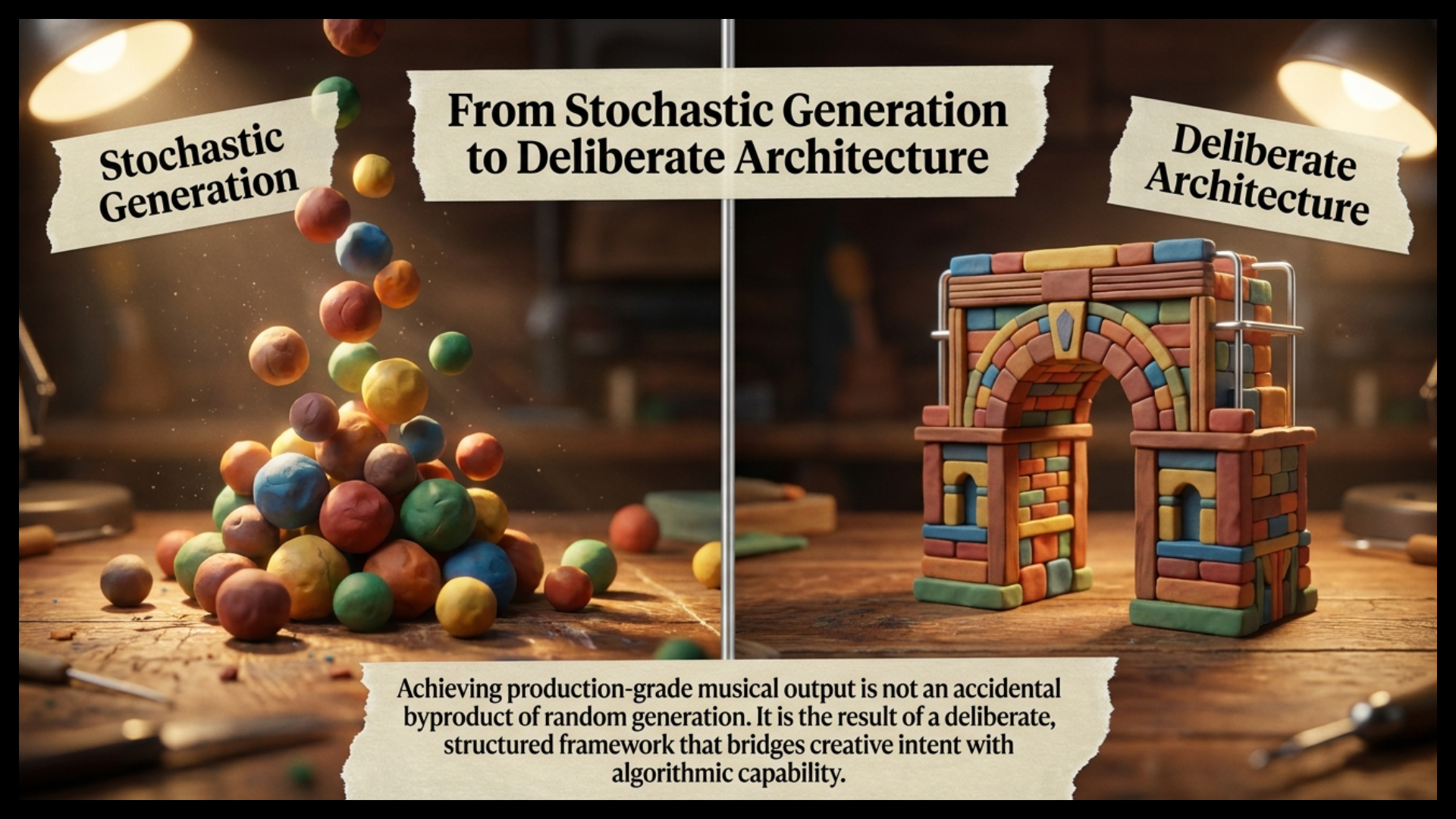
By treating the prompt as a modular blueprint rather than a vague request, creators can move beyond generic patterns toward masterful algorithmic orchestration. Here are the principles that guide the strategic transition from simple text entry to rigorous architectural design.

The Foundations of Effective Prompting: The CLEAR Framework
To avoid the "generic or misleading" outputs common in underdeveloped prompts, a foundational methodology is required. Without a structural approach, the AI defaults to the most probable (and often most cliché) musical tropes. Adapting the CLEAR Framework from established AI research provides a robust scaffolding for music generation:
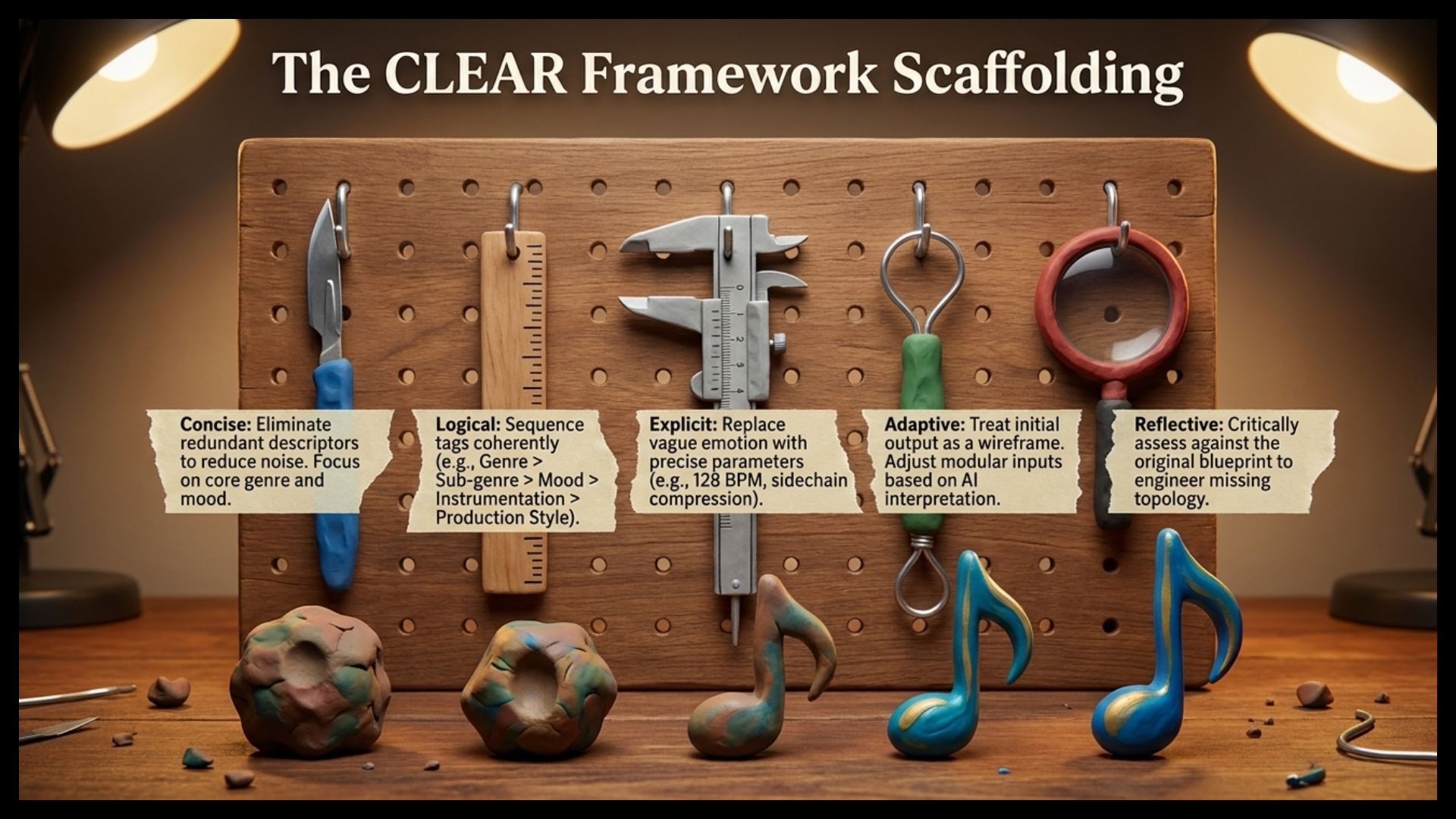
Concise: Eliminating redundant descriptors is essential. Overly verbose prompts introduce noise that can distract the model; focus on the core genre and mood to maintain a sharp sonic profile.
Logical: Style tags must be ordered in a coherent sequence the AI can parse .
Explicit: Vague emotional terms should be replaced with precise parameters. Specifying "128 BPM," "sidechain compression," or "staccato strings" provides the AI with actionable data rather than abstract concepts.
Adaptive: The initial output serves as a sonic wireframe. Architects must remain flexible, adjusting modular inputs based on how the AI interprets the rhythm or melodic contour in the first generation.
Reflective: A critical assessment of the result against the original blueprint is mandatory. Identifying where the prompt lacked a specific "topology" enables more intentional engineering in subsequent versions.
Engineering the Style Prompt: Establishing Musical Context
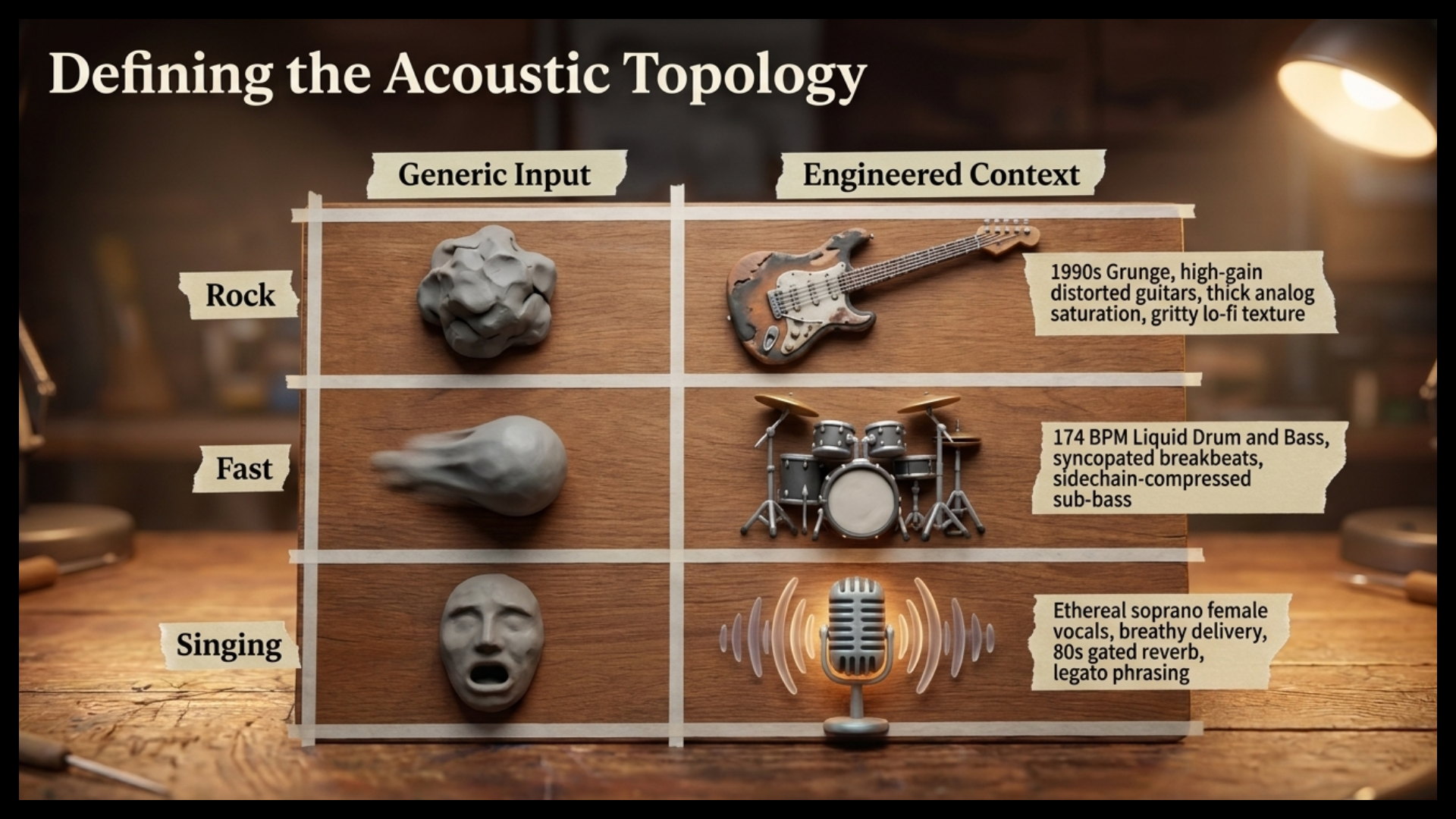
Establishing context is the most vital step in defining a song’s sonic identity. Because AI models are trained on diverse datasets, they require domain-specific knowledge to access niche musical territories. Using precise terminology, what we call "Acoustic Topology", minimises misinterpretation and forces the AI to draw from specific stylistic training. The following table demonstrates the shift from generic inputs to high-depth engineered context:
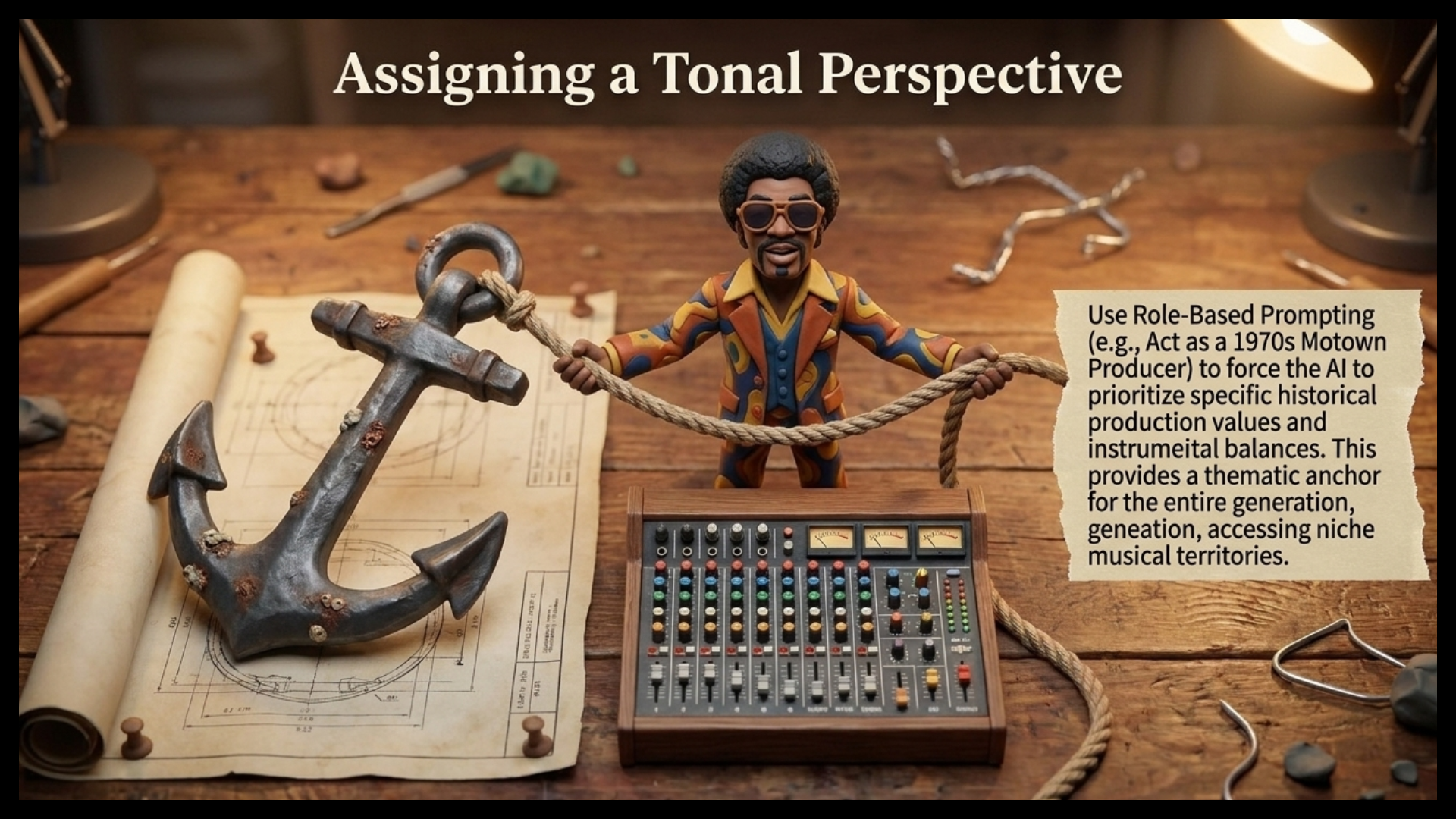
Role-Based Prompting (e.g., "Act as a 1970s Motown Producer") serves to shift the AI’s tonal perspective. By assigning a role, the architect instructs the model to prioritise specific historical production values and instrumental balances, providing a thematic "anchor" for the entire generation.
Connective Tissue: Interaction Between Style and In-Lyric Prompts
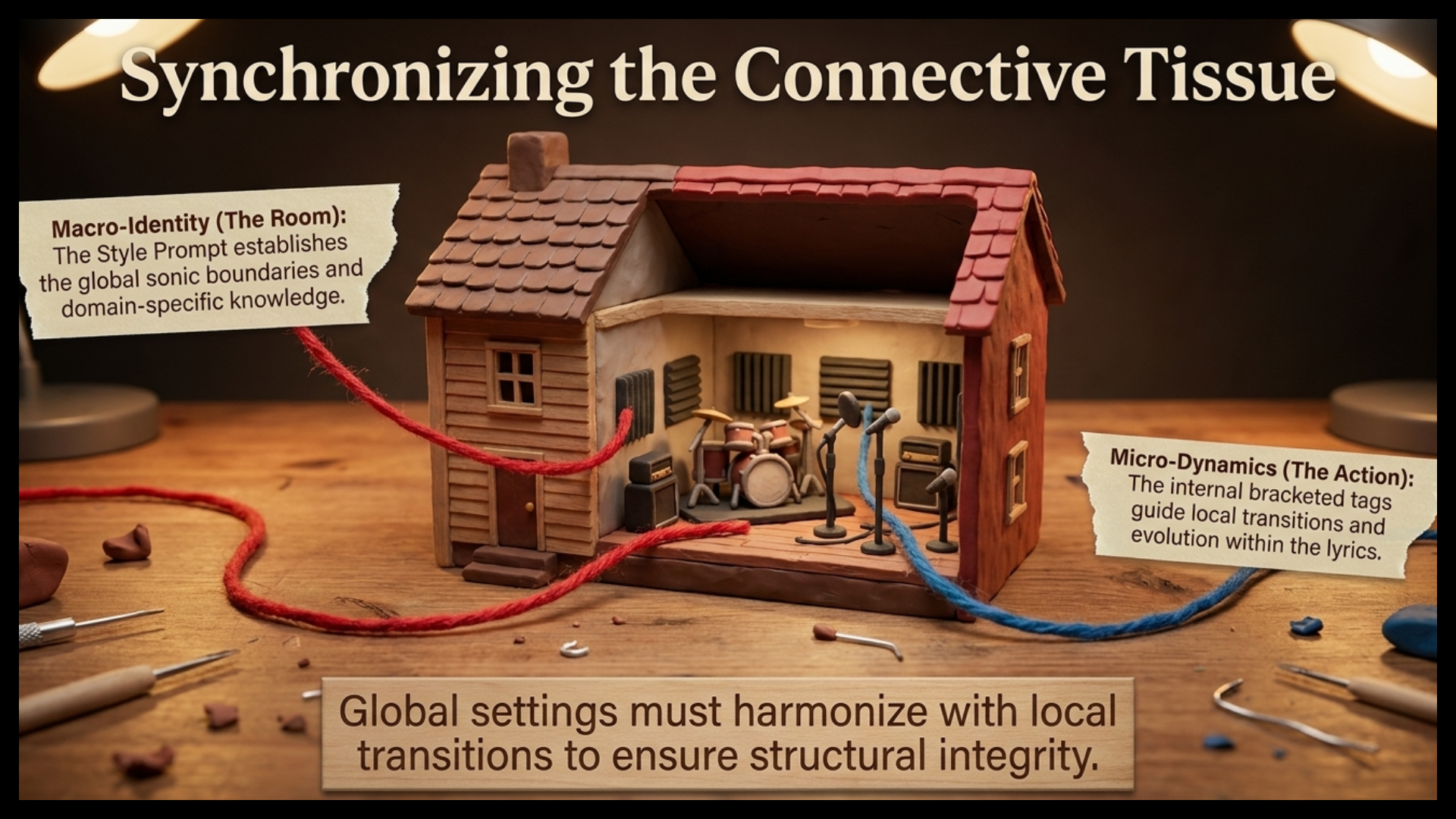
Effective music architecture requires synchronisation between the "Macro-Identity" (the Style Prompt) and the "Micro-Dynamics" (internal bracketed tags). This represents a multi-component task where global settings must harmonise with local transitions to ensure structural integrity.
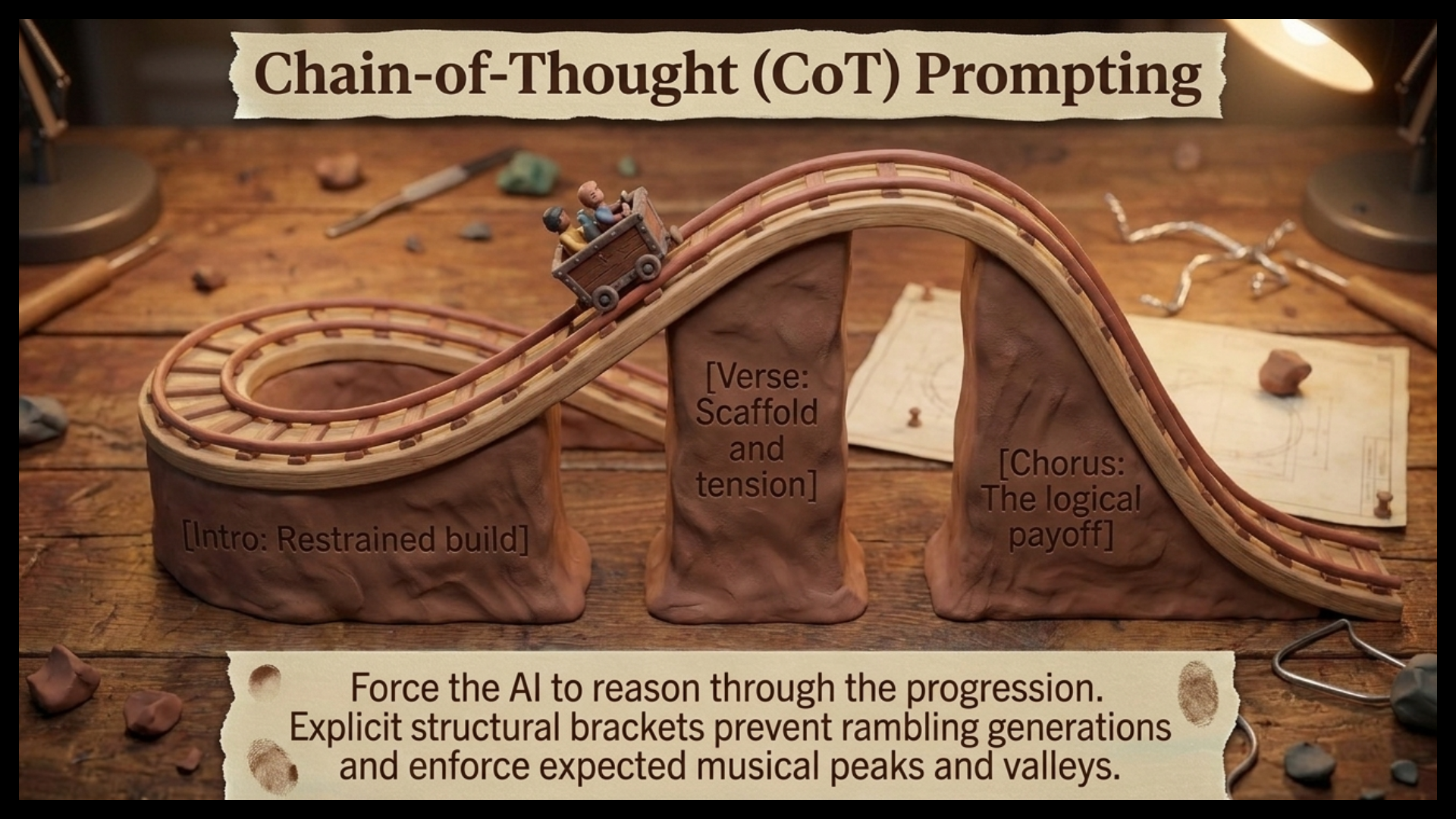
To maximise cohesion, architects should employ Chain-of-Thought (CoT) prompting within the lyric structure. Instead of isolated tags, the architect prompts the AI to "reason through" the song's progression, planning the intro's build, the verse's restraint, and the chorus's payoff. The strategic result of this synchronisation includes:
Macro-Identity vs. Micro-Dynamics: The Style Prompt establishes the sonic boundaries (the "room"), while in-lyric prompts guide the evolution. So what? This ensures the Chorus feels like a logical payoff to the Verse scaffold rather than a disconnected fragment.
Structural Adherence: Using explicit brackets like Drop, Bridge, or Outro enforces standard song structures. So what? This prevents "rambling" generations and ensures the AI respects the expected peaks and valleys of musical arrangement.
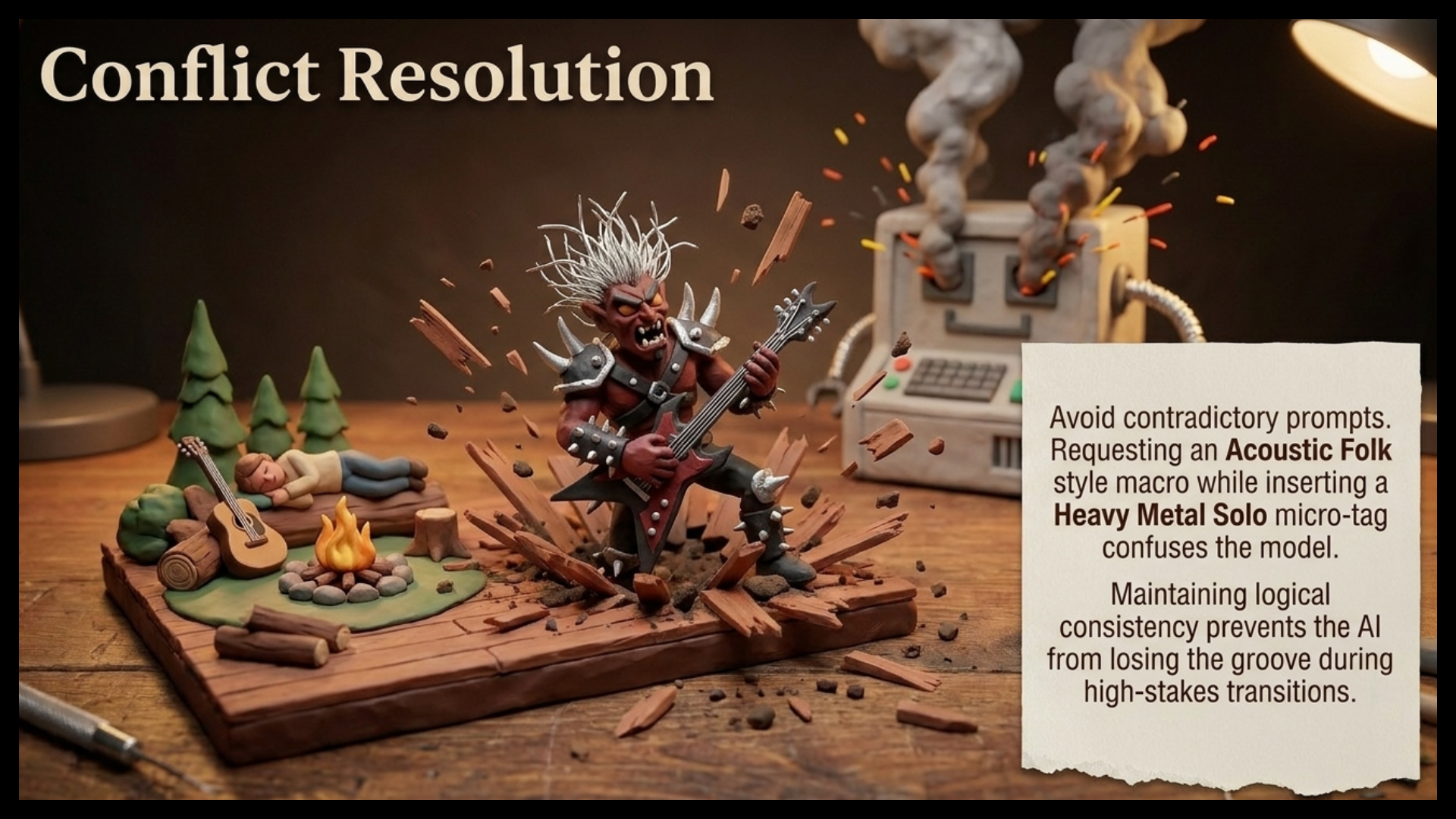
Conflict Resolution: Avoiding contradictory prompts is critical. Requesting "Acoustic Folk" in the style prompt while inserting a Heavy Metal Solo in the lyrics confuses the model. So what? Maintaining logical consistency prevents the AI from losing the "groove" during high-stakes transitions.
Iterative Refinement: The Path to Perfection
Prompt engineering is inherently iterative; the initial output serves as a sonic wireframe that requires refinement to meet production-grade standards. The Iterative Refinement Protocol ensures the final product aligns with the architect's vision:
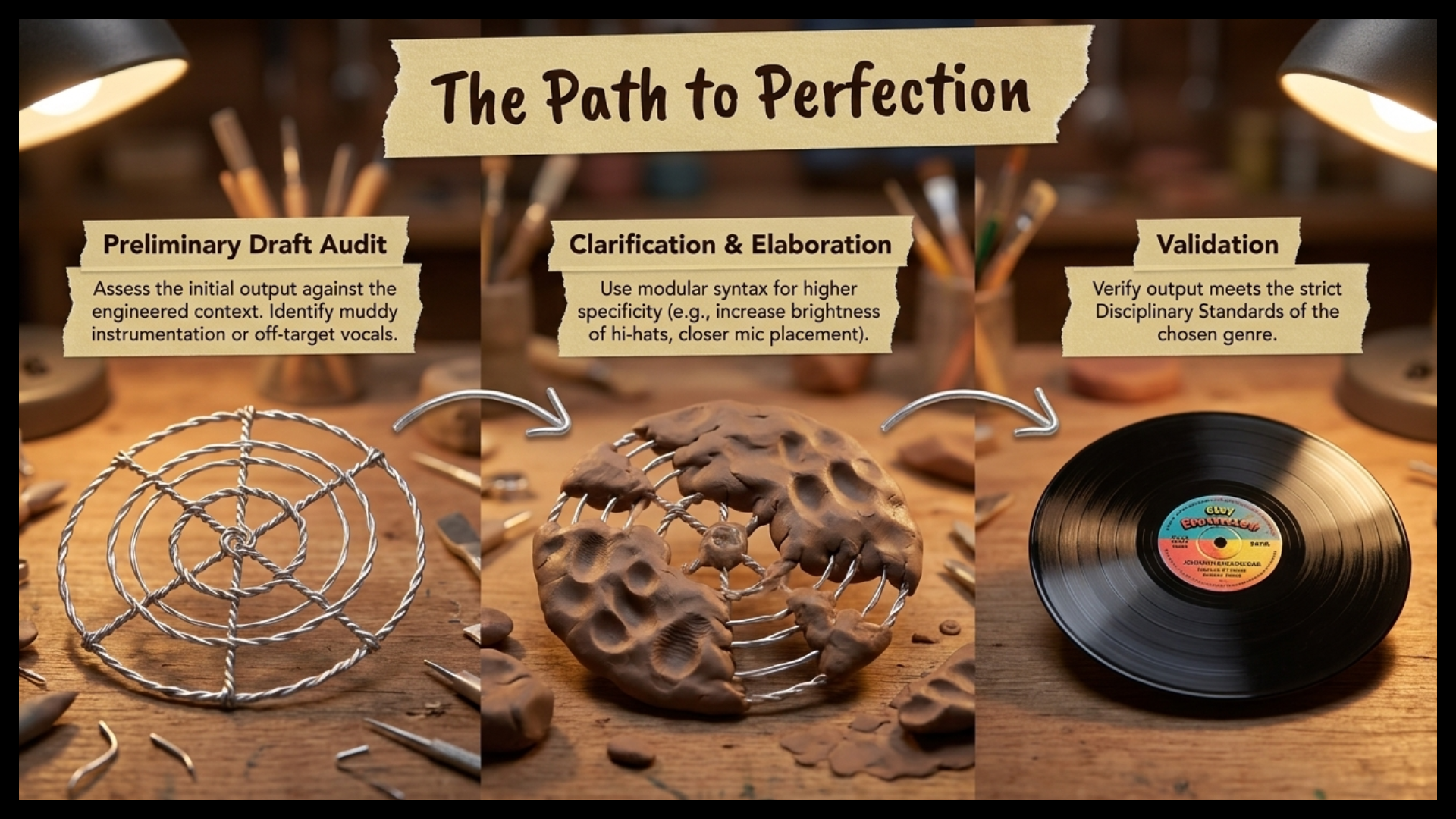
Step 1: Preliminary Draft Audit: Compare the first generation to the intended engineered context. Identify where the instrumentation is muddy or the vocal tone is off-target.
Step 2: Clarification and Elaboration: Use follow-up prompts or "Modular Syntax" to request higher specificity. For example, "maintain the beat but increase the brightness of the hi-hats and use closer mic placement for the vocals."
Step 3: Validation: Verify that the output reflects the "Disciplinary Standards" of the chosen genre.
Ensuring it is a technically sound representation rather than a mere imitation. Ultimately, human oversight remains the governing force. The AI provides the raw material, but the architect provides the critical judgment and final orchestration.
Safeguards and Ethical Considerations in AI Generation
While AI enables unprecedented scalability, it cannot replace the methodological rigour of a human creator. Architects must be vigilant against the following risks:
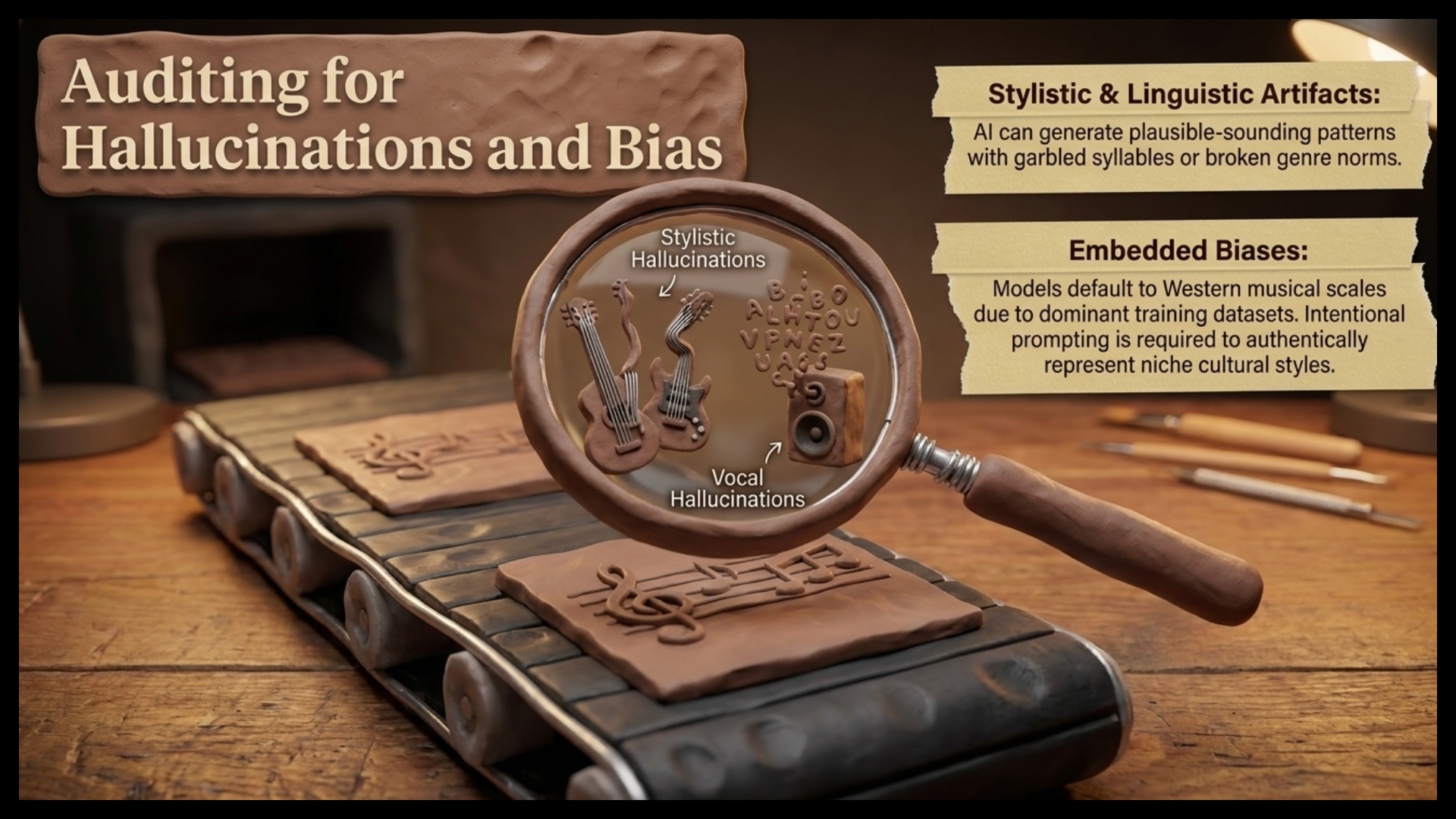
Stylistic and Linguistic Hallucinations: AI can generate "plausible-sounding" patterns that violate genre norms or produce "vocal hallucinations", nonsensical, phonetically garbled syllables. The architect must audit all output for these artifacts.
Embedded Biases: Because models are trained on dominant datasets, they often default to Western musical scales and paradigms. Awareness of these "dominant perspectives" is necessary when attempting to represent niche or emerging cultural styles.
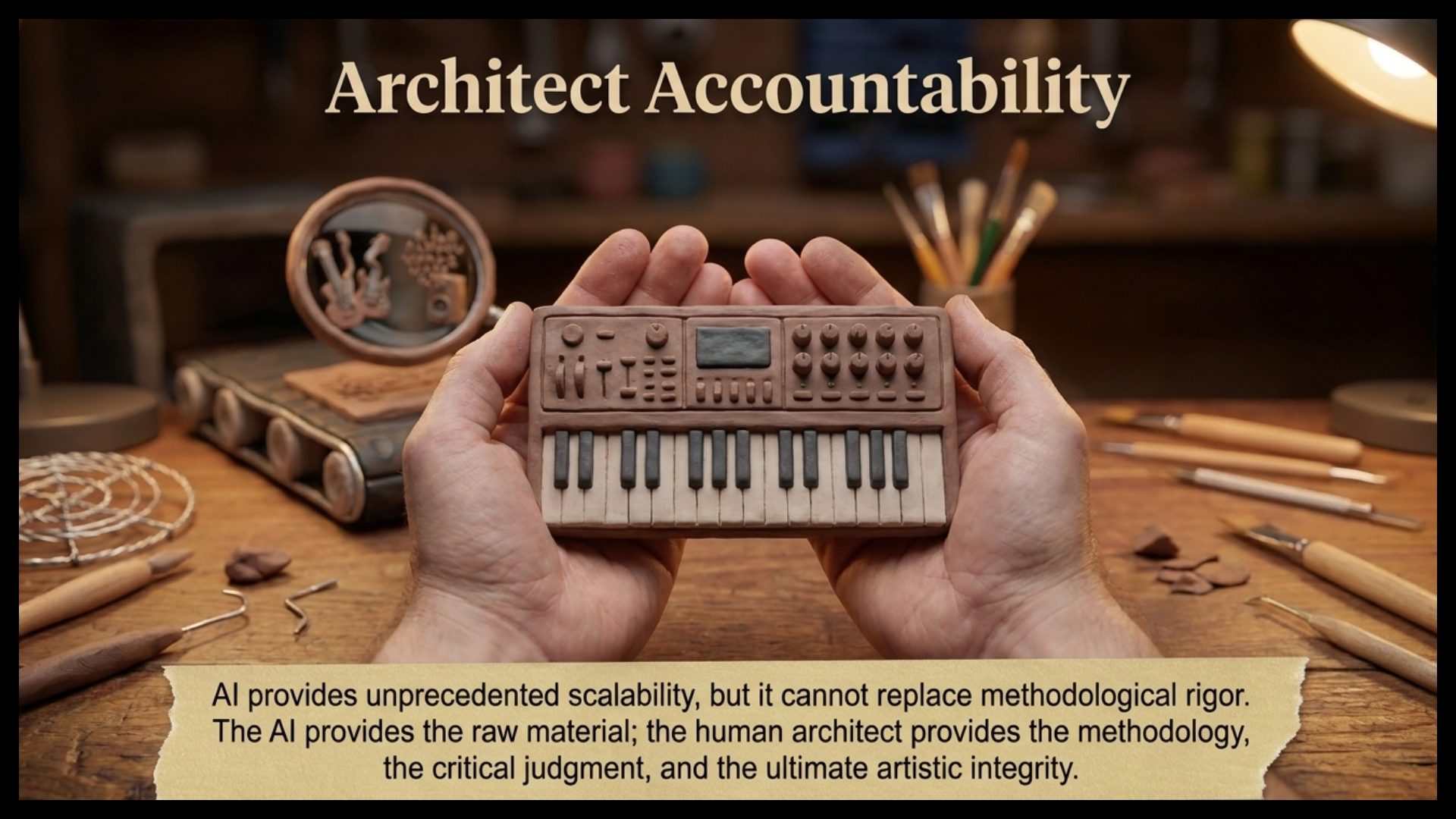
Architect Accountability: The final output is the responsibility of the human creator. AI-generated music must be reviewed for ethical appropriateness and technical accuracy to maintain the integrity of the creative process.

By utilising structured prompting to enhance the efficiency and scalability of generation, music architects can move beyond the "black box" of AI and achieve a level of creative control that bridges the gap between algorithmic potential and human artistry.
